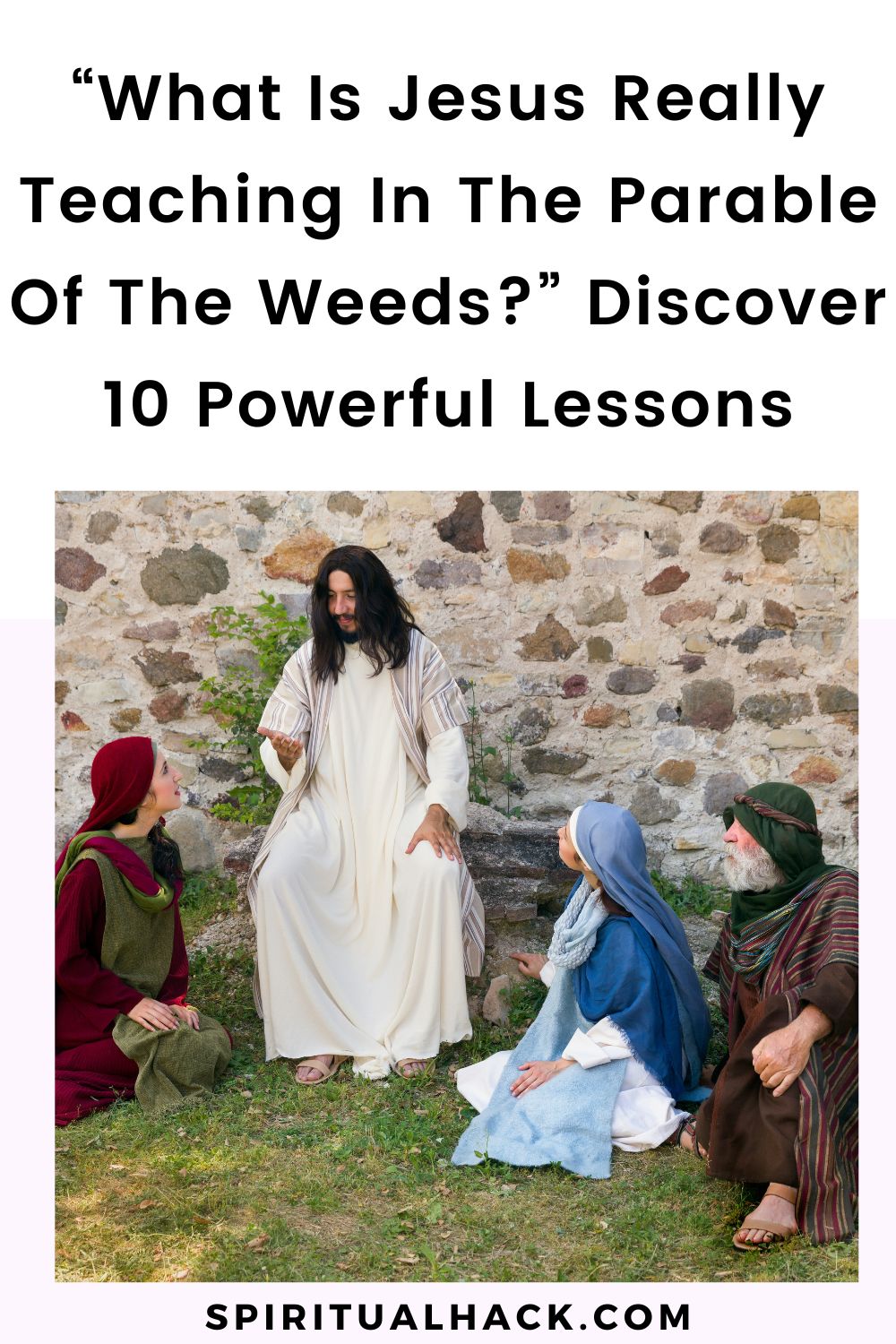

Ever heard the parable of the weeds? That’s one intriguing story Jesus told about a farmer, some sneaky sabotage, and a field full of surprises. I can almost hear you thinking, “What’s a story about farming got to do with me?”
Well, stick with me, because this ancient tale has more modern-day wisdom than perhaps you might expect.
This article will discuss ten surprising lessons from this parable. We will examine why good and evil often resemble each other and the power of patience in a world that wants everything now.
We will even dive into some big questions: God’s control in a chaotic world and how to stay strong when life gets tough.
Whether you are into spiritual pursuit, a curious sceptic, or even just looking for a fresh perspective on life, I promise you will find something intriguing here.
Let us go ahead and see how a simple story about weeds can change the way you look at the world.
1. Not Everything Is Black And White
You know, life would be so much easier if everything was neatly divided into “good” and “bad” categories, wouldn’t it? But as we grow older, we start to realize that the world is full of shades of Gray.
And that’s one of the key lessons which comes from the parable of the weeds.
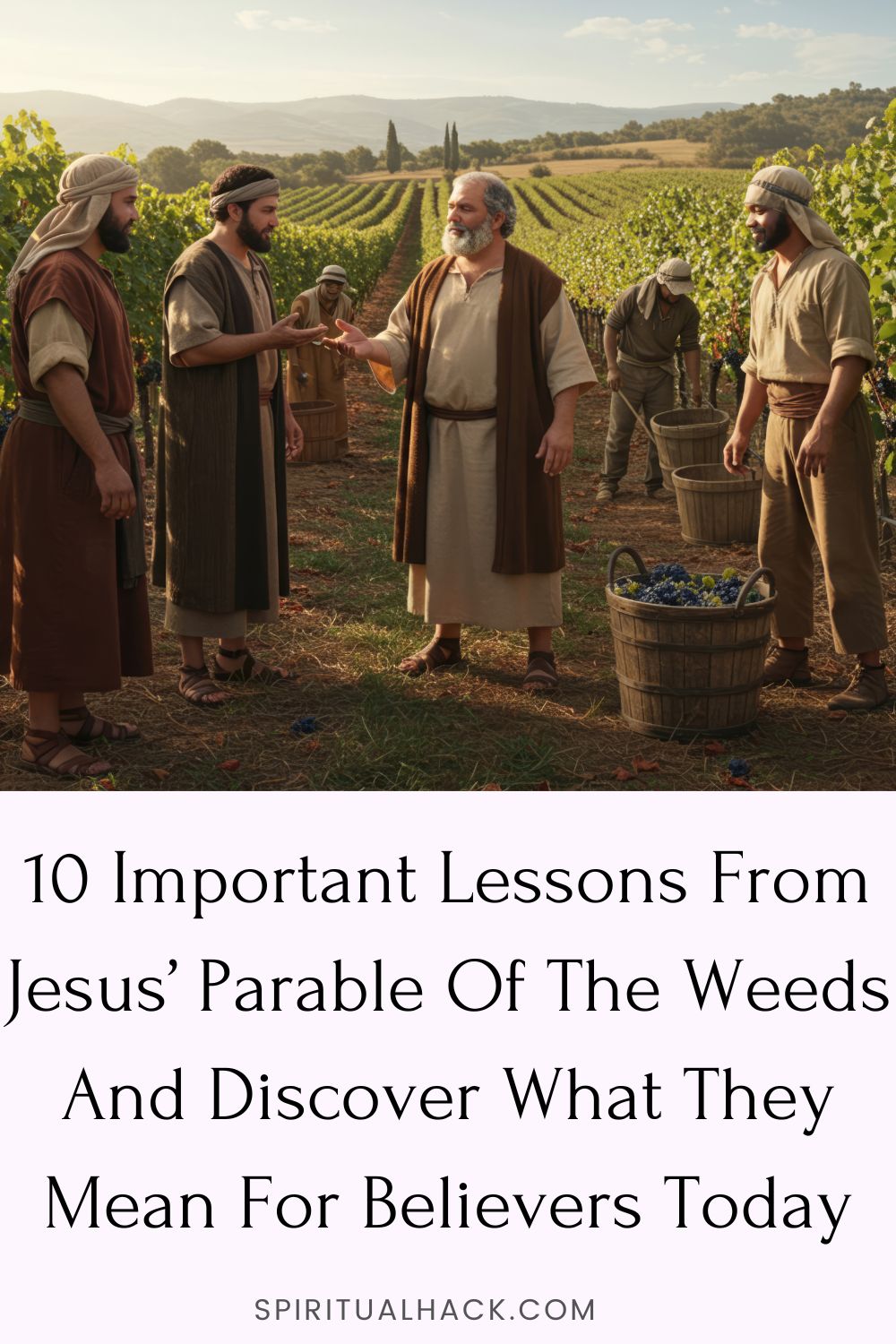
In the story Jesus used, wheat and weeds were growing together. To the naked eye, they appeared almost identical. It is only in their maturation that the difference was told.
Isn’t that just like life in some ways? Often, people and situations are not as they first appear.
I remember when I first started my job, there was this co-worker who seemed just so hard to get along with. I was quick to label them as a “weed” in my life.
Of course, with time, I realized they were dealing with personal issues I knew nothing about. It’s a lesson taught well: do not often judge too quickly.
The Bible warns us in Matthew 7:1-2, “Do not judge, or you too will be judged. For in the same way you judge others, you will be judged, and with the measure you use, it will be measured to you.”
This reminded one of the parable of the weeds: being really careful with our judgment since appearances can be deceiving.
2. Patience Is More Than A Virtue – It’s a Strategy
These days, with the pace at which life moves, it’s often as if patience were an art lost to the ages.
We want everything now-instant message, same-day delivery, on-demand entertainment. But the parable of the weeds teaches us that sometimes the wisest course of action is to wait.
You probably remember from the story how those farmhands wanted immediately to pull up the weeds. It was logical.
But the farmer, in his wisdom, said, “Wait.” He knew that a rash action might be worse than none at all.
I learned this the hard way in my own garden. One year, just trying to have a perfect lawn, I began to pull out everything that didn’t look like grass.
It turns out that I pulled up a bunch of wildflowers before they bloomed. Talk about a facepalm moment!
The Bible is full of encouragement to be patient. Psalm 37:7 says, “Be still before the Lord and wait patiently for him.”
And here, in the parable of the weeds, we see this patience enacted. It isn’t about twiddling our thumbs and not acting, but a strategic decision to let things happen organically, trusting in God’s timing.
3. God’s In Control – Even When It Doesn’t Look Like It

Have you ever had one of those days where everything seems to go wrong? Did you miss the alarm, spilt coffee on your shirt, and finally traffic jams?
It is easy in those moments to feel like the world is spinning out of control, but the parable of the tares ought to remind us of a comforting truth: God’s got this.
Well, the farmhands are rather freaked out when they discover the weeds, but not the landowner. He is as cool as a cucumber because he knows of them yet isn’t worried. He has a plan:
I think of losing my job some years ago. It was as if the whole world was caving in. But as I look back now, I realize it set me up for where I am today a job I love, doing work that matters.
At the time, it was weeds overrunning my life. God was cultivating something beautiful.
Romans 8:28 reminds us, “And we know that in all things God works for the good of those who love him, who have been called according to his purpose.”
The parable of the weeds is a really powerful reminder of this truth. Even when things in our eyes look messy or out of control, God is still sovereign.
4. Spiritual Warfare Is Real (And Closer Than You Think)
Now, I realize that the expression “spiritual warfare” often conjures up images of some kind of fantasy novel. So just bear with me if you would.
As a matter of fact, the parable of the weeds gives insight into a reality that too often is overlooked in our material world.
Remember how the weeds got there in the first place? An enemy snuck in and sowed them while everyone was sleeping.
Pretty tricky, huh? Yet, it’s really not so different from how those other influences work their way into our lives when we let down our guard.
I have found that in my own life. Once, I got into the routine of watching shows that, though very popular, were just replete with values that contradicted my faith.
Before I knew it, I found myself adopting attitudes and language that I wasn’t proud of. It was like tears were being sown in my heart while I was “sleeping.”
There is a warning in the Bible concerning this in 1 Peter 5:8, “Be alert and of sober mind. Your enemy the devil prowls around like a roaring lion looking for someone to devour.”
What the parable of the weeds does is call us to be awake as to what we permit to take root in our lives.
5. Looks Can Be Deceiving
We have heard it said, “You can’t judge a book by its cover,” but let’s get real-we do it all the time. We are to a great degree our first impressions.
We often pass judgment upon individuals, places or things based on shallow appeal without even thinking about it, at times. But the parable of the weeds challenges us to look deeper.
The weeds, also known as tares, in the story were almost indistinguishable from the wheat in their young stages of growth.
It wasn’t until they matured that the difference could be seen. What a powerful metaphor for life!
I will never forget when I first met my best friend. We seemed so different on the surface that I almost wrote her off.
As we got to know one another, though, I found a depth of character and shared faith in our friendship that has made it one of the most valuable in my life. If I had gone by first appearances, I would have missed out on this blessing.
1 Samuel 16:7 reminds us, “The Lord does not look at the things people look at. People look at the outward appearance, but the Lord looks at the heart.”
The parable of the weeds calls for a change in perspective toward the apparent conditions in a person and situations to release their true nature.
6. Growth Takes Time And That’s Okay

We know in our instant-everything world, the things that are best in life have to be forgotten by taking time.
We want to be experts overnight, to have success without struggle, to be spiritually mature without growing pains. But life just does not work that way, does it?
I remember the first time I started learning to play the guitar. I got so frustrated because right from the word go, I couldn’t play anywhere near my favourite musicians.
It took months of practice, sore fingers, and enough off-key notes that would have cleared any room before I could finally play a simple song. But you know what? That slow growth made the eventual success so much sweeter.
That’s exactly what we see in the parable of the weeds: The farmer doesn’t expect an instant harvest. He knows growth takes time, and he’s patient with the process.
What a beautiful reminder that our personal and spiritual growth is a slow and sometimes messy process-and that’s okay.
This is the very same premise derived from Ecclesiastes 3:1, “There is a time for everything and a season for every activity under the heavens.”
Just as the wheat from the parable requires some time to grow and mature, so do we. From the parable of the weeds, we learn patience with ourselves and others in growth.
7. We’re All In This Together
Haven’t you ever noticed how much more tolerable it is to be thrown into battle when you don’t have to face it alone?
There’s something powerful in the sense of community knowing you are not the only one struggling or striving. This is another beautiful lesson we might glean from the parable of the weeds.
In the story, the wheat and weeds grow together; they face the same conditions-the same challenges. It’s not too different from life-isn’t it?-all of us in this thing together, facing similar struggles and joys.
I remember some of the worst times of my life. It was lonely; it was overwhelming, until one night I opened up with my small group at church, and it was no longer a struggle. We struggled together; we prayed for each other, through thick and thin.
Hebrews 10:24-25 exhorts us, “And let us consider how we may spur one another on toward love and good deeds, not giving up meeting together, as some are in the habit of doing but encouraging one another.”
It is the parable of the weeds that reminds us we are not supposed to trudge through life alone; we’re all part of the same garden and help each other as we grow.
8. There’s A Day Of Reckoning Coming
I know this may sound a bit heavy, but bear with me here. The parable of the weeds does not flinch from the fact that there is a day of judgment. It’s not the most comfortable topic to consider, but it is nonetheless an important one.
The time does come, as it does in this parable when wheat has to be separated from tares. Quite disconcerting, isn’t it? It reminds us that for everything we do, a consequence has been set out.
I once recall this time in my workplace when tempted to take a shortcut-not exactly illegal, but rather unethical. The thought of future consequences made me think twice and opt to act with integrity.
This is not to scare us but to challenge us to live purposeful lives. It says in Galatians 6:7-8, “Do not be deceived: God cannot be mocked. A man reaps what he sows. Whoever sows to please their flesh, from the flesh will reap destruction; whoever sows to please the Spirit, from the Spirit will reap eternal life.”
The parable of the weeds keeps in our minds we must not only consider consequences that immediately follow from our actions but reach into the future.
Are we planting the seeds that become the fruit which benefits our lives and the lives of others?
9. God’s Timing Is Perfect [Even When We’re Impatient]

Waiting is hard, isn’t it? Whether it is waiting for test results, for a relationship to develop, or for a dream to come true, patience doesn’t come easily to most of us. But the parable of the weeds gives a powerful lesson about trusting God’s timing.
You probably remember how the farmer in the story had to wait for the right time to harvest. He was not in a hurry to do this, even when his workers were anxious to pull up weeds. There is wisdom in that patience.
I remember feeling desperate about finding a job. I applied to every open position I could find and interviewed for many of them, only to not get the job.
It was frustrating and disheartening. Of course, in looking back, I see how God was preparing me for the perfect opportunity.
Isaiah 55:8-9 says, “For my thoughts are not your thoughts, neither are your ways my ways,” declares the Lord. “As the heavens are higher than the earth, so are my ways higher than your ways and my thoughts than your thoughts.”
The parable of the weeds really shows this, reminding us that God’s time is always right, even when His timing is different from our own.
10. Staying Strong When The Going Gets Tough
Life isn’t all easy-going, is it? We all experience our fair share of challenges, setbacks, and times when everything seems to go against us. Herein lies a powerful lesson to be taken in the parable of the weeds.
Now, think of the wheat in the story: it had to grow among weeds, competing for its nutrients and space. Still, it grew and finally came into its harvest. Therein is great resilience!
It leads me to one specific instance of my life where I went through chronic sickness. Some days, I wanted to let go the agony and tiredness were just unbearable.
But I hung on to my faith, leaned on my support system, and kept going. Like the wheat among weeds, it is in the struggle that I grew tougher.
James 1:2-4 says, “Consider it pure joy, my brothers and sisters, whenever you face trials of many kinds because you know that the testing of your faith produces perseverance. Let perseverance finish its work so that you may be mature and complete, not lacking anything.”
It is so richly illustrated with the parable of the weeds. So, even in discouraging situations, the possibility of growing and thriving-even producing an abundant harvest-is within our reach.
Next time things get really tough, just remember the stubborn wheat and keep pushing!
Conclusion
The parable has taught us about the reality of spiritual warfare and the need to watch out. It has shown us something about the value of community and a well-grounded discernment in a world where things are often not as they appear.
We’ve been called upon, when necessary, to bear with patience difficulties that may challenge our perseverance, trusting God’s timing-even when a human would have given up.
Perhaps most importantly, this parable reminds us that our choices do count. Just as the wheat and weeds grew together, we, too, live in a world where good and evil coexist.
But the power of choice lies with us as to how we will grow and what kind of fruit we bear in our lives.
Now that you have these insights, what will you do with them? How may they further change how you think of your circumstance or relate to others?
As I close, I invite you to reflect deeply on some of these lessons and how to apply them in daily life. Like the wheat in the parable, we too are called to grow and flourish in the midst of adversity.
Let us heed this ancient wisdom and become compassionate, more incisive, faith-filled women. For is it not what a good parable does: challenge us, change us, and make us grow?
As you go about your week, keep an eye out for the ‘weeds’ and ‘wheat’ in your own life. You may well be surprised by how much more you could go on learning from this unassuming, yet profound, story.
And who knows? You may even find yourself relating the parable of the weeds to another who needs its timeless wisdom.
Save this for later!