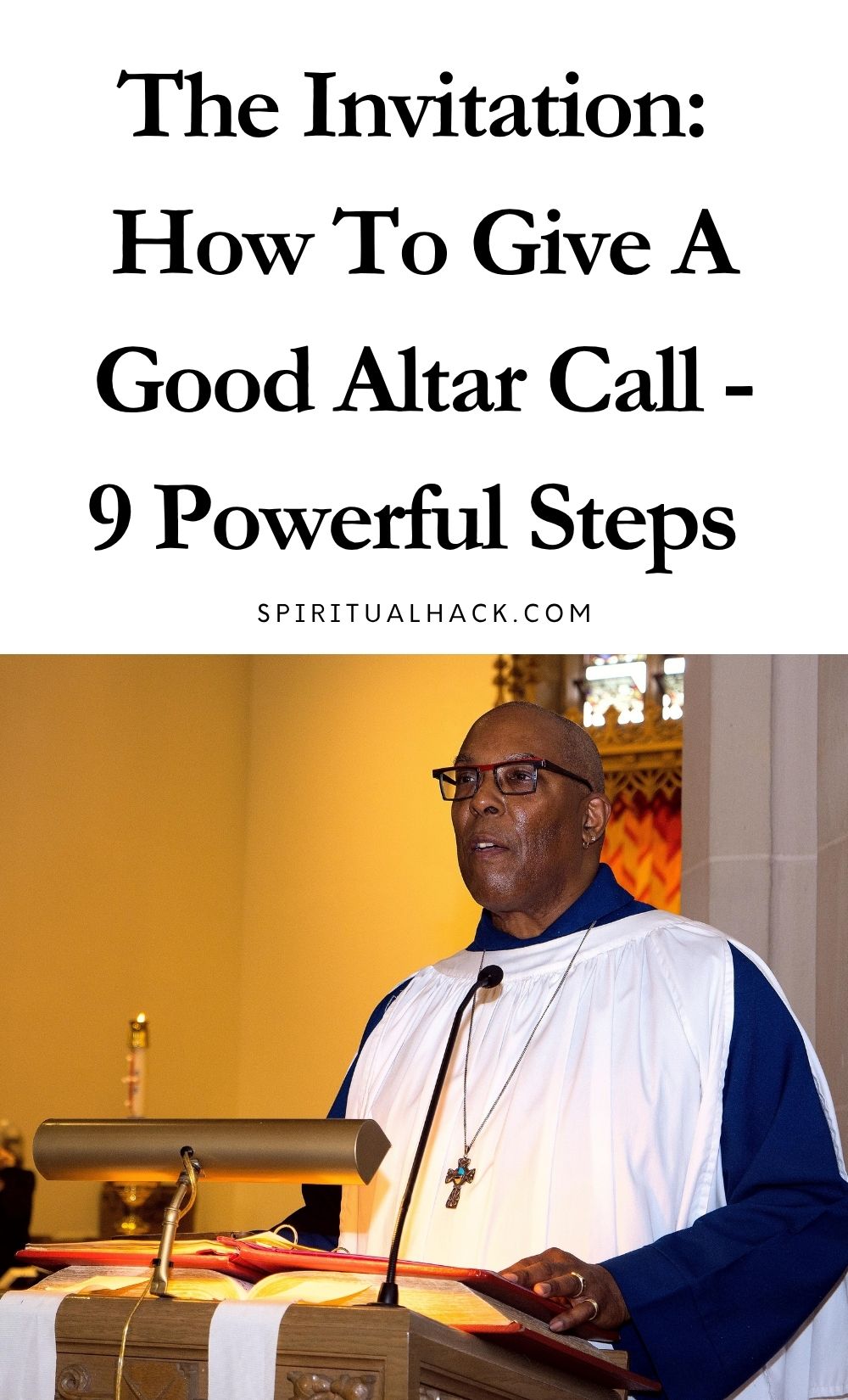

Learning how to give an altar call is an important aspect for any minister or church leader who desires to make real-life moments of spiritual change possible.
Whether one is a seasoned pastor or newly minted as a youth group leader, extending an altar call effectively has potential significantly to influence their congregation and thereby affect life-changing encounters with God.
In this comprehensive guide, we will explore nine potent ways to extend an altar call that touches the heart and induces action.
We’ll consider what spiritual and practical preparation looks like and then explore how to create an atmosphere to which people will respond.
You’ll learn how to craft compelling messages, time your invitation perfectly, and use language that invites rather than pressures.
Have you ever felt like a fisherman, wanting to cast your net to hopefully draw people closer to God but unsure of using the right technique?
By the end of this article, you will be equipped with a toolbox of methods in which to be enabled as a skilled “fisher of men,” proficient at creating opportunities for people to take that crucial step toward going deeper with God.

1. Preparing Yourself Spiritually
Well before you ever step up into the pulpit, take a moment to pause and reflect.
Remember, extending an altar call is not about what you say or even how you say it, but more about being a conduit of God’s love through you.
I learned this lesson the hard way early in my ministry when I tried winging it without proper spiritual preparation.
Pray, inviting the Holy Spirit to guide your every thought and word. Pray, as you meditate on Scripture, that God would reveal His heart for your congregation.
One thinks of the example of the prophet Isaiah’s experience recorded in Isaiah 6:8, “Then I heard the voice of the Lord saying, ‘Whom shall I send? And who will go for us?’ And I said, ‘Here am I Send me!'”.
This is an attitude that we are to cultivate as we prepare ourselves to give an altar call.
Seek wisdom from mentors or fellow ministers who have been down this road before. Their insights will be invaluable to you as you learn how to give an altar call effectively.
Your own spiritual health comes first, Jesus explained in Matthew 7:5: “First take the plank out of your own eye, and then you will see clearly to remove the speck from your brother’s eye.”
2. Setting The Right Ambiance
Consider this: You are about to deliver a powerful message, and there go the humming fluorescent lights above, the cranked-up air conditioning, and a cell phone that will not stop ringing.
Not quite what you want to create for a spiritual experience. This is why setting the right atmosphere is key when you determine how to give an altar call that really moves.
Your church is like a garden in which, with every service, you are growing your atmosphere.
Much as a gardener would attend to soil, sun, and water, you will want to give thought to things such as lighting, music-even seating.
Soft, warm lighting can make it feel more intimate, while the right music can help hearts be opened to God’s presence.
But it’s not just about the physical environment. The emotional and spiritual atmosphere makes a difference. Lead your congregation to cultivate an attitude of waiting expectations.
Remind them from Hebrews 11:1, “Now faith is confidence in what we hope for and assurance about what we do not see.”
Allow people to feel secure being vulnerable before God and with each other.
And don’t underestimate silence. Sometimes, in our zeal on how to give an altar call, we rush to fill every moment with words or music.
But remember, it was in the “gentle whisper” that Elijah heard God’s voice (1 Kings 19:12). Allow moments of quiet reflection where people can hear God speaking to their hearts.
3. Crafting A Compelling Message

Now, let me elaborate on the core of how to give an altar call: the message itself.
This is not the time for some dry theological lecture or a feel-good pep talk. You’ve got to paint this vivid picture of God’s love and grace that would urge people into immediate response.
Determine what the one key truth is that you are trying to convey.
Maybe the life-changing effect that comes in knowing God’s forgiveness, or perhaps hope based on trusting in God’s will.
Whatever it is, it should not be used as the thread that weaves your whole message together.
Frame your words, remembering the power of storytelling. Jesus often used parables to bring across spiritual truth, and we would do well to take a cue from Him.
Offer personal testimonies of how God’s call is changing a life or even real-life examples. Stories work because they allow people to see themselves within the story and imagine their lives.
Not being afraid to address common struggles and doubts, and acknowledge barriers that may make people hesitant to respond.
In so doing, you show empathy, allowing a safe space for honest reflection. As you learn how to give an altar call that truly connects, you will find that honesty and vulnerability go a long way.
Always focus your message on the Word. Allow the Word of God to be the foundation of your altar call.
As stated in Isaiah 55:11, “So is my word that goes out from my mouth: It will not return to me empty, but will accomplish what I desire and achieve the purpose for which I sent it.”
4. Timing Your Altar Call
Timing, as they say, is everything. And when it comes to giving an altar call, that couldn’t be any truer.
I once had an over-eagerness early in my ministry to give an altar call, rushing through my sermon and blurting out an invitation before the congregation had time to process what they’d heard. Needless to say, the response was less than enthusiastic.
Learning how to give an altar call means cultivating a sense of spiritual timing. It means being attuned to the movement of the Holy Spirit in your service.
Sometimes, you might get the urge to give the call prior to when you had scheduled it. Other times you may need to wait, allowing a moment of worship or reflection to prepare hearts.
Pay attention to the energy in the room. Are people engaged and responsive, or do they seem distracted or resistant?
Look for signs that hearts are being softened-maybe you notice tears in someone’s eyes, or see people nodding in agreement with key points of your message.
Do you recall the story of how Philip and the Ethiopian eunuch met in Acts 8? Philip did not immediately start preaching the moment he met the man.
He asked a question, “Do you understand what you are reading?” and waited until the right time, when curiosity and openness were evident in the eunuch, before being able to declare the good news about Jesus.
Don’t be nervous to simply stop and pray silently, asking God to lead you concerning when to extend the invitation.
Jesus prayed in John 5:19, “Very truly I tell you, the Son can do nothing by himself; he can do only what he sees his Father doing.” Seek the same sensitivity of God’s leading in your altar calls.
5. Using Clear And Inviting Language
Now, extending the altar call, you want to use plain clear words. You must avoid using flowery terms or big theological words now.
This is like being a tour guide, showing others the directions toward a life-changing meeting with God.
Use clear and direct language that cannot be misunderstood. I once heard a pastor extend an altar call so vaguely that people weren’t sure whether he was inviting them to accept Christ, rededicate their lives, or just come forward for prayer.
Don’t make that mistake. Be specific about what you’re inviting people to do and why.
Along with this, make sure you can be friendly in your tone without using language that conveys condemnation or even forcing a decision.
Remember, it’s an invitation, not a command. Allow people to respond by opening the opportunity this way: “You’re welcome to come forward” or “If you feel God tugging at your heart, I invite you to respond.”
Provide a variety of ways people can respond. Some will be able simply to walk to the front while others will raise a hand or submit a response card.
The idea is to eliminate as many barriers as possible for those who will make a move toward God.
You want to learn how to give an altar call but don’t leave out the power of Scripture to invite and encourage.
You may want to use words such as these from Revelation 3:20: “Here I am! I stand at the door and knock. If anyone hears my voice and opens the door, I will come in and eat with that person, and they with me.”
Let your words remind people of the heart of God in chase after them with unrelenting love.
Be that bridge of words to help bring others over from hesitation into decision, from fear into faith, and from isolation into communion with God himself.
6. Including Physical Movement

There’s something powerful about physical movement during a spiritual moment.
I once recall watching a seasoned pastor masterfully guide his congregation through an altar call.
It wasn’t just words; he invited the people to take literal steps toward God. The physical act became a powerful metaphor for their journey.
Don’t underestimate the power of physical movement when thinking about extending an altar call.
An invitation to come forward can be one of the most poignant moments. It reminds me of the account recorded in Mark 10:49-50 where Jesus says, “Jesus stopped and said, ‘Call him.’
So they called to the blind man, ‘Cheer up! On your feet! He’s calling you.’ Throwing his cloak aside, he jumped to his feet and came to Jesus.”
But coming to the front is not the only way. Some may want simply to raise a hand where they are while others may want to move to a special prayer area.
Options should be provided for people to physically respond to what has become an internal decision; such an action can help them cement their commitment and make the moment more memorable.
Consider establishing a holy space in your church for such moments. It can be as simple as a prayer rail or as elaborate as you can make it, but it’s about having a physical space that represents a meeting place with God.
As you continue refining your way of how to give an altar call, feel free to try ways of incorporating movement that feels organic to your community and respects the weightiness of the moment.
7. Following Up
Giving an altar call is a beginning, not a destination. I learned this lesson at the very beginning of my ministry.
I witnessed people make the most heart-felt of commitments in an altar call and be left to struggle alone in the days that followed. That’s when the importance of follow-up support really hit me.
Think of it this way: if altar calls are about planting seeds, follow-up support is about nurturing those seeds to help them grow into strong, healthy plants.
It is here that the serious work of discipleship truly surfaces. So as you consider how to give an altar call that has lasting impact, always plan for what comes next.
Identify a team of compassionate responders who can provide immediate care for respondents.
These may be elders, small group leaders, or mature believers who are able to pray with people, encourage them, and then help integrate into the broader life of the church.
Remember Paul’s encouragement in 1 Thessalonians 5:11: “Therefore encourage one another and build each other up, just as in fact you are doing.”
Provide resources to help people continue in their spiritual journey. This could be through Bible reading plans, devotionals, or small groups/directions of discipleship. That would be pointing them toward the next step in faith.
Don’t underestimate the magic of personal follow-up. A call, a text, or a handwritten note in the days following an altar call can make all the difference in the world.
It tells people that this matters and they’re not alone. As you continue to fine-tune your altar call process, be reminded that the moments after the call are equally as important as the call itself.
8. Different Answers Handling
Every appeal to the altar is unique, and responses can be radically different from others. I will never forget giving what I felt was a dynamic altar call and getting no response.
Right when I was going to conclude the service, discouraged by such, an elderly gentleman made his way slowly to the front, tears cascading down his face.
It was a powerful reminder that God works in different ways with different people.
Learning how to give an altar call means being prepared for any response. A few may come forward in a mad dash; others may hang back, counting the cost of their decision.
Some may come weeping; others may come resolute, yet silent. The point is to provide space wherein all such responses are welcome and respected.
For the ones that appear hesitant, offer words of gentle encouragement, but do not push. As Jesus said in Matthew 11:28, “Come to me, all you who are weary and burdened, and I will give you rest.”
Sometimes people just need to be reminded they’re invited to come as they are, doubts and all.
Don’t be discouraged if that is not the response you were expecting. If one person responds, that’s cause for celebration! S
econd Chronicles 30:6b says, “I tell you, there is rejoicing in the presence of the angels of God over one sinner who repents.” Every response, no matter how meagre, is significant in the eyes of God.
Be prepared to handle emotional responses with a great deal of grace and wisdom. Have tissues ready and train your prayer team to bring comfort and support, without getting overwhelmed.
As you continue to sharpen your approach to giving altar calls, you will become more sensitive to the various ways people might respond to God’s invitation.
9. Learning From Experience

The journey of mastering how to give an altar call is never really over. Every time you give that invitation, you learn something new.
I remember my first altar call; I was so nervous I could hardly stutter out a word and forgot half of what I wanted to say.
But do you know what? People responded anyway. Our imperfections don’t limit God’s power.
Take time to reflect after each altar call. What went well? What didn’t go so well? Ask people on your team that you trust for their observations.
Were there times when people were engaged or moved in some manner? Were there times when it felt like the energy in the room shifted? These may be great ways to fine-tune your approach to altar calls.
Don’t be afraid to try different methodologies. Perhaps you try adding a period of silent reflection before the invitation, or you use some symbolic action such as lighting candles.
The apostle Paul spoke about becoming “all things to all people so that by all possible means I might save some” (1 Corinthians 9:22). The same adaptability can extend to the way we offer altar calls.
Remember, the goal is not perfection but faithfulness. As long as you are seeking to genuinely connect people with God, you’re on the right track.
Proverbs 16:3 says, “Commit to the Lord whatever you do, and he will establish your plans.”
So commit your altar calls to God, learn from each experience, and trust that He will use your efforts for His glory.
As you continue to grow in this area, remember to celebrate your victories. Be it great or small, every respondent to an altar call is another life that God’s love has touched.
Let these moments fuel your passion and remind you of why you do what you do.
Your journey of learning how to give an altar call is part of the greater story of God’s redemptive work in the world. Rejoice and joyfully anticipate what God is going to do next.
Conclusion
Giving an effective altar call involves a combination of art and science, blending spiritual sensitivity with practical skills.
These nine strategies will equip you to be very potent in bringing people to moments of decision and change in your ministry.
Remember, the objective is not just to make people respond now, but to make sure that such a moment, when people encounter God, serves as a catalyst for ongoing spiritual growth.
Refine your altar call methodology as you go along. Keep listening to the Holy Spirit to modify your strategy in whatever way He may lead.
Each congregation is unique, and what works terrifically in one place may need tweaking in another. Just keep it real; keep it caring and keep people connected with God’s love and grace.
Essentially, it means giving an altar call: that bridge that transfers people from earth to heaven, an invitation to people to step into another chapter of their spiritual journey.
With practice, prayer, and above all, perseverance, you too can be the master extending this invitation to touch a life and change a heart, one altar call at a time.
Save this for later!Learn how to give an altar call, invit